SodaTide Official Website › Blog › The Akkermansia Claim This Site Won't Make
The Akkermansia Claim This Site Won't Make
SodaTide's own ingredients page reports that the seller's FAQ names Akkermansia muciniphila while explaining how the formula is meant to work. The label itself names no species. This article is about the distance between those two facts, and what the one human trial on this organism actually tested.
- The seller's own FAQ names Akkermansia muciniphila once, while explaining how the formula is supposed to work — not as a declared ingredient.
- The one human supplementation trial on this organism (Depommier 2019) gave 10¹⁰ pasteurised cells a day for three months to 40 enrolled volunteers, 32 of whom completed it.
- Insulin sensitivity improved by about 29% and total cholesterol fell; body weight moved by roughly two kilograms.
- The authors call it a proof-of-concept exploratory study. It was not a study of this product.
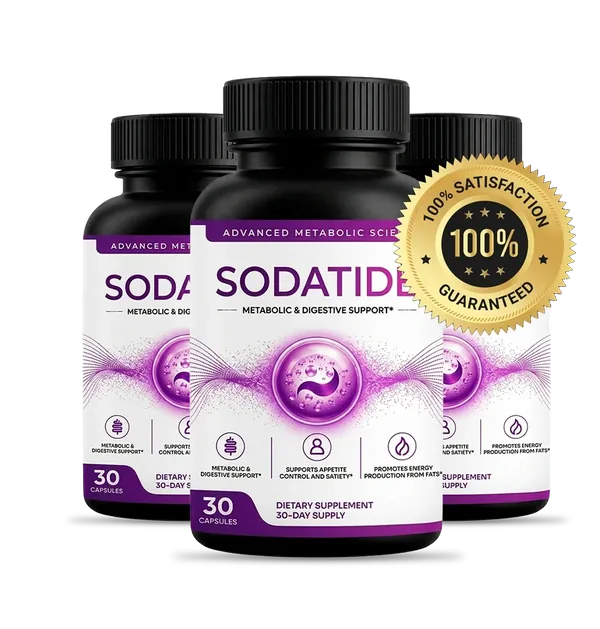
- This bottle's label carries no species name, so a marketing mention cannot be checked against what a capsule actually contains.
What the seller's FAQ actually names
SodaTide's own ingredients page records a specific fact about the product's own marketing: the seller's FAQ names Akkermansia muciniphila once, in the course of explaining how the formula is supposed to work. It does not appear in an ingredient list. It does not appear on the panel — because no Supplement Facts panel exists in the artwork this product ships with. It does not appear beside a colony count, a species confirmation, or a serving claim of any kind. It appears in a sentence about mechanism, the kind of sentence that explains why a category of ingredient might matter before it tells a reader what is actually inside the capsule in front of them.
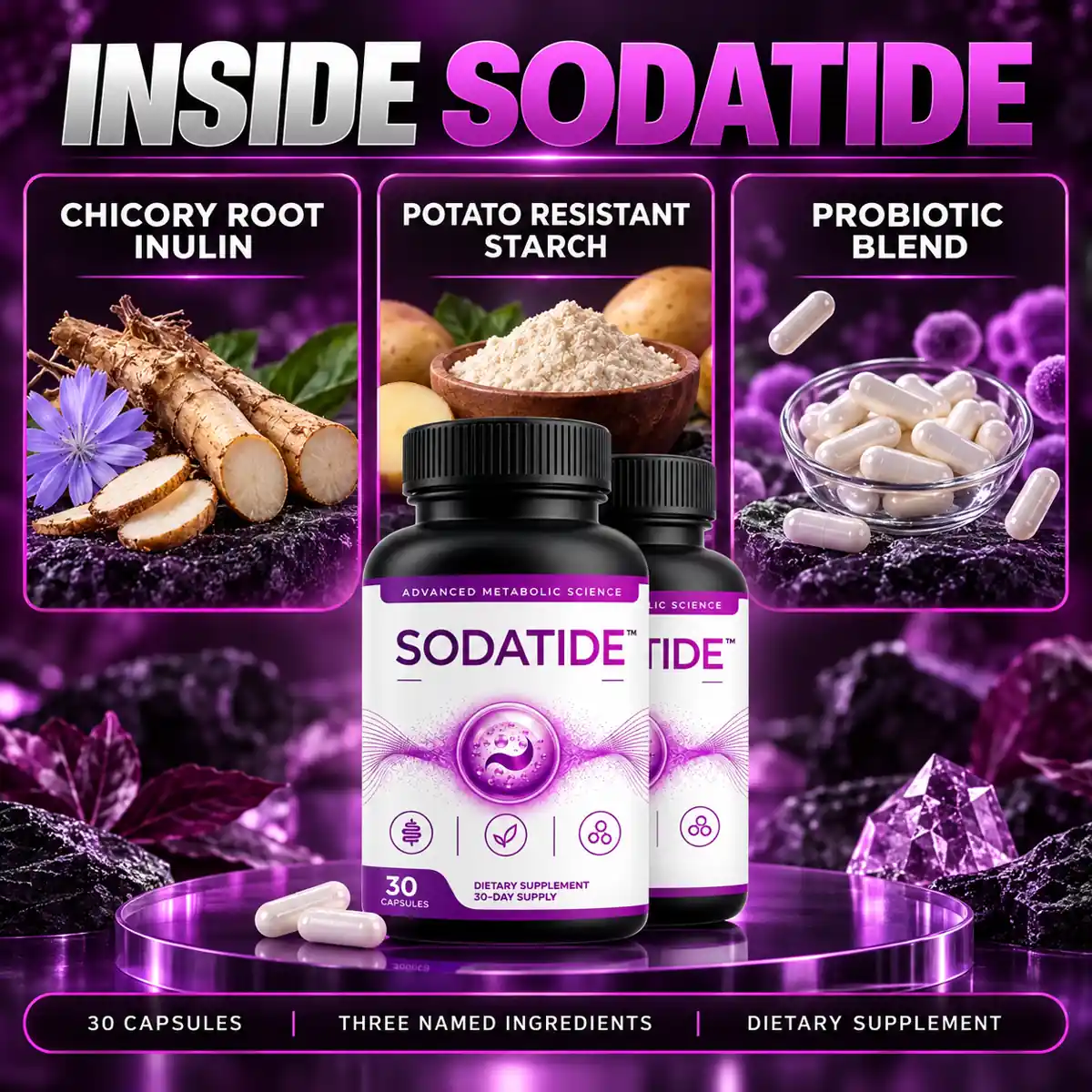
That distinction is the entire subject of this article. The label SodaTide ships prints three ingredient names: chicory root inulin, potato resistant starch, and a probiotic blend. The probiotic blend carries no genus, no species, no strain designation and no colony-forming-unit count, on this bottle or in any image supplied with it. Akkermansia is not one of the three named ingredients. It is a word that appears once, elsewhere, in a different kind of sentence — and the gap between an explanatory mention and a content claim is exactly what most readers skim past.
This site's own ingredients page has already taken a position on that gap: it declines to claim the organism is in the bottle, specifically because the label confirms no species. That refusal is recorded in the site's own citation file. This article exists to unpack why that refusal is the only honest position available, by setting out in full what the one relevant human trial on this organism actually tested.
The Depommier trial, read in full
Depommier and colleagues, publishing in Nature Medicine in 2019, ran the study that everything said about Akkermansia muciniphila in a human-supplementation context ultimately traces back to. Forty overweight, insulin-resistant volunteers were enrolled; thirty-two completed the protocol. The intervention was daily oral supplementation with the organism at 1010 cells a day, continued for three months, and the authors report it was safe and well tolerated across that period — a meaningful finding on its own, since a mucin-degrading organism taken as a live supplement was not a foregone safety conclusion going in.
On outcomes, the pasteurised form of the organism improved insulin sensitivity by about 29% and reduced total cholesterol; body weight moved by roughly two kilograms over the three months. Those are the headline numbers, and they are genuinely interesting ones for a single pilot study of an organism that had almost no human intervention data behind it before this paper. They are also, and this matters for everything that follows, the numbers from a trial the authors themselves describe as a proof-of-concept exploratory study — their words, not a paraphrase invented for this article. A proof-of-concept study is a first step, not a settled finding, and the paper does not claim otherwise.
It is worth being precise about what that trial tested and what it did not. It tested a defined, quantified dose — 1010 cells a day — of a specific, identified organism, delivered under trial conditions, for a defined three-month period, in a randomized, placebo-controlled design, with outcomes measured by people who knew exactly what they were giving each volunteer and how much of it. Every one of those conditions is a variable. Every one of those variables is exactly the kind of information this bottle's label does not carry for its own probiotic blend, named organism or not.
What naming an organism commits a seller to
There is a real difference between an explanatory mention and a content declaration, and probiotic science is unusually strict about which one actually matters. The International Society of Sports Nutrition's position stand on probiotics is explicit on this point: health benefits in this category are strain- and dose-dependent, not species-general and certainly not genus-general, and a product should carry the genus, species and strain of each organism it contains, plus the estimated count at the end of shelf life — not at the moment of manufacture, when counts are at their highest and least representative of what a buyer actually swallows months later.
Set that standard next to what a FAQ mention actually does. A sentence that says, in effect, “here is an organism researchers have studied, and here is roughly why it might be relevant to what this category of product claims to do,” is an explanation of a mechanism that has been studied somewhere, by somebody, under some conditions. It is not a statement that this organism, at this count, survives in this capsule. Those are different claims with different evidentiary requirements, and a marketing page that makes the first one has made no commitment at all about the second.
This is not a uniquely dishonest move and it is worth saying so plainly. Explaining mechanism by reference to the wider literature on a category of ingredient is standard, legitimate practice across the supplement industry, and it happens on well-run sites and poorly-run ones alike. The problem is not that the mention exists. The problem is what a reader is left to assume once they have read it, and whether anything on the label actually confirms or denies that assumption. On this bottle, nothing does.
| What a FAQ mention is | What a label declaration is |
|---|---|
| A sentence explaining why a category of organism is thought to matter, with a citation or a plain-language summary behind it | A printed genus, species and strain, tied to a specific product and a specific batch |
| Written to persuade a reader that the category is worth their attention | Written to be checked — against a certificate of analysis, a lab test, or a regulator |
| Can reference a study of any product, or of no product at all, as long as the organism matches | Can only be true if the organism is actually present, at the count stated, in the bottle on the shelf |
| Survives a single fact-check: does the organism exist, and has it been studied? | Requires an ongoing fact-check: is it still present, at that count, at the point of sale? |
| Costs a seller nothing to include or remove | Costs a seller a great deal to get wrong, once a reader learns to look for it |
The left column describes what appears in SodaTide's own FAQ, per this site's ingredients page. The right column describes what does not appear on this bottle, for any of the three named ingredients.
Ask a single question: does this sentence tell me what is being studied, or does it tell me what is in the bottle in my hand? A mechanism explanation answers the first question. Only a label, a Supplement Facts panel, or a certificate of analysis tied to this specific batch answers the second. If a page gives you the first and you walk away believing you have the second, the page has not lied to you — but you have filled in a gap it left open, and it is worth knowing you did it.
Akkermansia muciniphila, in plain terms
Akkermansia muciniphila is a mucin-degrading bacterium that lives in the mucus layer lining the gut. It is not an exotic laboratory curiosity; it is a substantial and normal part of a healthy adult gut community, typically making up somewhere in the region of one to three percent of the total bacterial population in stool, though that figure varies considerably between individuals. What made it a research target in the first place is observational: across a number of human and animal studies, its relative abundance runs inversely to obesity and to untreated type 2 diabetes, meaning people and animals with less of it in their gut tend, on average, to show worse metabolic markers.
Observational association is not the same as a causal, dose-tested intervention, which is exactly why the Depommier trial matters as much as it does — it is one of the few pieces of human evidence that moves past correlation into an actual supplementation trial with a measured dose and a measured outcome. It is also, as the paper's own authors state, a single proof-of-concept study. A single pilot study, however well designed, is the start of an evidence base, not its conclusion, and nothing in that paper licenses a claim that any product containing any amount of this organism will reproduce a 29% insulin-sensitivity improvement.
Why this is a different question from the blend's silence
This site has published a separate article on the SodaTide probiotic blend generally — on the fact that the label names no species, no strain and no count for any of the organisms the blend is described as containing. That piece argues a broad point: a probiotic label that names nothing at the species or strain level cannot be matched to any trial in either direction, because probiotic evidence belongs to specific strains rather than to the word “probiotic” in general.
This article is asking a narrower and, in a sense, a harder question. It is not about the blend's general silence. It is about the one specific instance where the seller's own marketing broke that silence and named an organism by name, in the context of explaining mechanism. The question this article asks is: given that one specific naming, what does it actually establish about what is in the capsule? And the answer, worked through in full above, is: nothing that the label itself confirms. The mention tells a reader that Akkermansia muciniphila has been studied and that the study found something. It does not tell them whether this product contains it, at what count, in what form, or at all.
That is a genuinely different failure mode from a blend that names nothing. A blend that names nothing is honest about its own opacity in a backhanded way — there is no specific claim to hold it to. A mention that names one organism, in passing, while leaving the label itself silent, creates an impression without creating a claim that can be checked. Both leave a buyer in the same practical position, unable to verify what they are taking, but they get there by different routes, and conflating the two would miss what is actually happening on this particular page.
What would actually settle this
The fix is not complicated, and it is the same fix this site's ingredients page already lists for the blend as a whole: genus, species and strain designation for every organism present, and a colony-forming-unit count specified at the end of shelf life rather than at manufacture. If Akkermansia muciniphila is genuinely present in this formula at a meaningful count, printing that fact costs the seller nothing and answers the only question this article has been asking. If it is not present, the FAQ mention should be read for what it currently is: an explanation of why a category of organism is interesting, not a statement about this bottle's contents.
Independent verification exists as a stronger check still. DNA-based authentication methods can confirm what species and strains are actually present in a finished probiotic product, and a growing body of laboratory-audit literature has looked specifically at how often commercial probiotic labels match what independent testing finds — a subject this site covers in a separate article on what DNA testing finds in probiotic products generally. Until a label, a certificate of analysis, or an independent test settles the question for this specific product, the honest position is the one this site's ingredients page already takes: the mention is recorded, the refusal to claim it is recorded beside it, and the reader is left with an accurate account of what is actually known rather than a comfortable one.
References
- Depommier C, Everard A, Druart C, et al. Supplementation with Akkermansia muciniphila in overweight and obese human volunteers: a proof-of-concept exploratory study. Nat Med. 2019;25(7):1096-1103. PMID 31263284. https://pubmed.ncbi.nlm.nih.gov/31263284/
- Jager R, Mohr AE, Carpenter KC, et al. International Society of Sports Nutrition Position Stand: Probiotics. J Int Soc Sports Nutr. 2019;16(1):62. PMID 31864419. https://pubmed.ncbi.nlm.nih.gov/31864419/