SodaTide Official Website › SodaTide Ingredients
SodaTide IngredientsSodaTide Ingredients: All Three, And What Each One Is
SodaTide names three ingredients: chicory root inulin, potato resistant starch and a probiotic blend.
Two are fermentable carbohydrates that reach the colon intact; the third is live bacteria. The artwork supplied with this product prints no amount for any of them and carries no Supplement Facts panel, so this page sets each ingredient beside the dose its published trials used.
Three ingredients, the evidence behind each, and the one piece of information the label withholds.
What is actually in a SodaTide capsule?
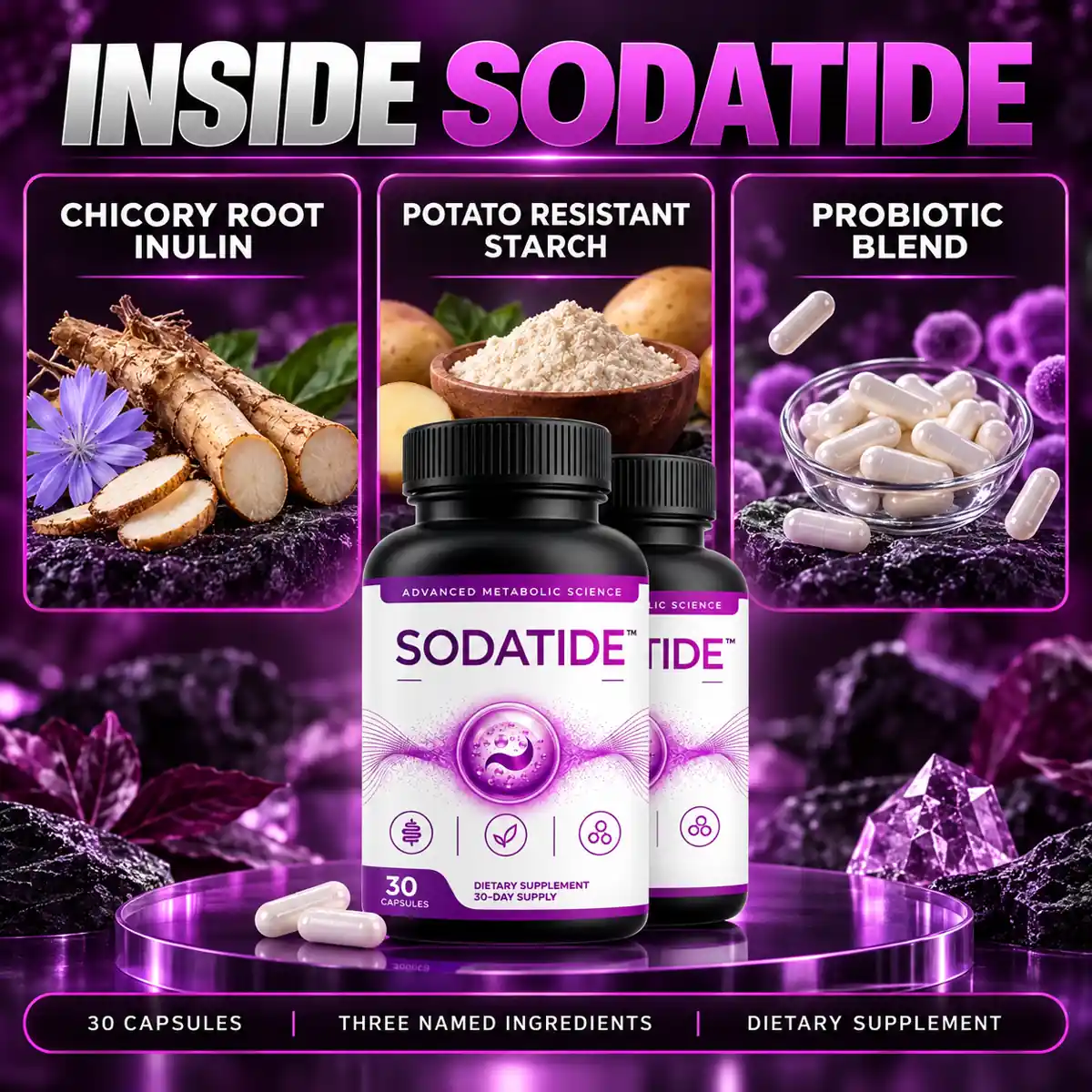
Three names and nothing else. That is the whole of the formula as the pack states it, and it is worth being precise about what has and has not been checked here. Every image the vendor supplies was opened: the two-bottle cutout, the three- and six-bottle shots, the ingredient graphic above, the everyday-use scene and all eight compliance roundels. None of them shows a panel, a serving box, a milligram or a colony count.
So the comparison table below is the only honest shape this page can take. In the left column, what the bottle says. In the right, the amount the published trials fed people. A reader can then do the arithmetic that the label declines to make possible, and this desk would rather hand over that arithmetic than pretend it does not matter.
A size 0 vegetable capsule holds roughly 400 to 500 mg of powder in total. One capsule a day is therefore under half a gram of everything combined, against fibre trials that ran from 5 to 45 grams a day. That is the gap, and no amount of good writing about the mechanism closes it.
Chicory root inulin, the first ingredient in SodaTide
Inulin is a fructan: a run of fructose units joined end to end and capped with a single glucose. Chicory builds it in the root across a growing season and lives on it through the winter, which is why the root rather than the leaf is what gets harvested. No enzyme in the human small intestine will touch the bond that joins one fructose to the next, so the whole chain reaches the colon as it was swallowed and is fermented there. The ISAPP consensus statement treats it as the archetypal prebiotic, and it has more human trials behind it than the rest of this category combined.
The dose where things start happening is known with unusual precision for a supplement ingredient. A double-blind crossover in thirty healthy adults gave 5 g and 8 g a day in a chocolate drink for two weeks each; both raised bifidobacteria against placebo, and a higher proportion of volunteers responded at 8 g. A 200-person dose-response study tested seven nondigestible carbohydrates at 2.5 to 10 g a day and found that long-chain inulin specifically was not bifidogenic in its screening phase, while short-chain fructo-oligosaccharides were — which is a reminder that 'inulin' covers a family of chain lengths that do not behave identically.
On the outcomes people actually buy it for, the picture is real but modest. A 2024 meta-analysis of 32 chicory inulin trials found reductions in body weight, BMI, fat mass and waist circumference, with minimal evidence that dose, duration or the type of fructan changed the size of the reduction. An earlier systematic review of fifteen adult trials found eleven showing no effect on daily energy intake at all, and two of three that measured body weight showing a reduction. Both of those statements are true at once, which is what a modest effect looks like.
| Trial | Dose used | Duration | What it found |
|---|---|---|---|
| Kolida 2007, healthy adults | 5 g and 8 g a day | 2 weeks each | Both doses raised bifidobacteria; more volunteers responded at 8 g |
| Nicolucci 2017, children 7–12 | 8 g a day | 16 weeks | Lower body fat percentage and trunk fat, and a lower BMI z-score |
| Marteau 2011, constipated older adults | 15 g a day | 4 weeks | More bifidobacteria, less difficulty, mild flatulence reported |
| Micka 2017, adults with constipation | 12 g a day, as 3 × 4 g | 4 weeks | More stools a week and softer stools than maltodextrin |
| Verhoef 2011, healthy adults | 10 g and 16 g a day | 13 days | Energy intake fell 11% on 16 g; the 10 g arm did not |
Doses read from each paper's own abstract during this build.
Held against a capsule, those figures do the work this page exists to do. The lowest dose with a published effect on gut bacteria is five grams a day. A size 0 capsule holds four to five hundred milligrams of everything combined. Unless this bottle uses a capsule size that does not appear in any of its photographs, the inulin fraction is a fraction of a fraction of what the trials used.
Potato resistant starch, the second ingredient in SodaTide
Resistant starch is ordinary starch that has taken on a physical form amylase cannot get at. In a potato it happens when the potato is cooked and then chilled: the gelatinised starch recrystallises into a structure the small intestine leaves alone. Reheat it gently and much of the resistance survives. This is the one ingredient in the formula that a reader can manufacture in their own kitchen for nothing, and that fact belongs on this page rather than out of it.
The trial that used potatoes rather than maize is worth reading in full. Sanders and colleagues gave nineteen adults with a BMI between 27 and 40 three hundred grams a day of cooked, chilled potato — about two potatoes, roughly eighteen grams of resistant starch — spread across lunch, an evening meal and a snack over twenty-four hours, then measured insulin sensitivity after an overnight fast. It was a pilot, and the comparison was against isoenergetic carbohydrate foods rather than against nothing.
The larger literature uses high-amylose maize and larger doses. Johnston and colleagues gave forty grams a day for twelve weeks to insulin-resistant adults and found improved insulin sensitivity by clamp, with no change in body weight or ectopic fat. Gower and colleagues found the response in women depended on where their insulin sensitivity started. And White and colleagues gave forty-five grams a day for twelve weeks to adults with prediabetes and found no effect on appetite, on food intake at a buffet, or on GLP-1, PYY and ghrelin.
- Insulin sensitivity, at 40 g a day for 12 weeks, measured by clamp (Johnston 2010).
- A single-day insulin-sensitivity signal from ~18 g of potato resistant starch, in a 19-person pilot (Sanders 2021).
- Not appetite. A 12-week trial at 45 g a day found nothing (White 2020), and an acute 48 g study reduced intake at one later meal without changing how full anybody said they felt.
- Not body weight on its own. A systematic review of resistant starch and obesity found the metabolic signals stronger than the anthropometric ones.
A review of resistant starch and energy balance makes the point that matters for a capsule: resistant starch is a substrate, and a substrate has to be present in gram quantities to be fermented in gram quantities. DeMartino and Cockburn add a second: which bacteria a given resistant starch feeds depends on the granule structure, so two products labelled 'resistant starch' can ferment differently. Neither point is an argument against the ingredient. Both are arguments for a label that says how much of it there is.
The SodaTide probiotic blend, and the strains it does not name
The label says 'probiotic blend'. It does not say which bacteria, how many species, or how many live organisms are in a capsule at the end of shelf life. The seller's page describes three strains and names one of them in passing while answering a question about mechanism. The bottle names none.
For a fibre, a missing number is a problem of scale. For a probiotic it is a problem of identity, and the difference is worth stating carefully. The ISSN position stand on probiotics is explicit: health benefits are strain- and dose-dependent, the minimum effective dose depends on validation studies for that particular strain, and a product should carry the genus, species and strain of each organism plus the estimated count at the end of shelf life. A blend without those cannot be matched to a trial even in principle.
How much that matters is visible in the best-documented example in the field. Kadooka and colleagues gave 87 adults fermented milk containing Lactobacillus gasseri SBT2055 at 10⁸ cfu per gram, 200 g a day for twelve weeks, and measured a 4.6% fall in abdominal visceral fat area by CT. A follow-up in 210 people then asked whether lower concentrations worked, and found roughly 8% reductions at both 10⁷ and 10⁶ cfu per gram. The strain is named in the title of both papers, because the strain is the finding.
| What a probiotic label should carry | What this label carries |
|---|---|
| Genus | Not stated |
| Species | Not stated |
| Strain designation | Not stated |
| Colony-forming units per capsule | Not stated |
| Count at the end of shelf life | Not stated |
| Storage instruction | Refrigerate after opening — stated, and unusual enough to be meaningful |
| Number of strains | Described as a blend; the seller's page says three |
The storage line is the one row in this table the label does answer, and it is the row that suggests the organisms are meant to arrive alive.
The wider evidence for mixed probiotics in this use case is real and small. A meta-analysis of fifteen trials in 957 adults with overweight or obesity found reductions in body weight and fat percentage. An earlier meta-analysis found a small BMI effect. A 2025 meta-analysis looked specifically at visceral fat. A review restricted to Lactobacillus found the results split by species, with some reducing body fat and some doing nothing.
Two further things a buyer should know about probiotic labels generally. DNA-based authentication work exists precisely because label and contents have not always matched, and a laboratory audit of commercial products found poor correlation between label claims and measured identity, viability and counts. That is an argument for buying probiotics whose labels are specific, not an accusation about this one — but a label that names nothing cannot be checked against anything.
The Akkermansia question, and why SodaTide cannot be sold on it
The seller's own FAQ names Akkermansia muciniphila while explaining how the product works. It is a genuinely interesting organism — a mucin degrader whose abundance runs inversely to obesity and untreated type 2 diabetes in observational work — and the human data is one study. Depommier and colleagues enrolled forty overweight, insulin-resistant volunteers, thirty-two completed, and daily oral supplementation at 10¹⁰ cells for three months was safe and well tolerated. The pasteurised form improved insulin sensitivity by about 29% and reduced total cholesterol; body weight moved by about two kilograms.
That is a proof-of-concept exploratory study, its authors call it one, and it is cited here for one reason only: it is the clearest available demonstration of why a buyer would want the strain list. If this capsule contains that organism at that count, that is a real and specific thing to say. If it does not, the mention on a sales page is decoration. The label settles neither question, so this desk declines to claim it either way, and the refusal is recorded in the site's own citation file rather than left as an omission.
What a better SodaTide label would print
- Grams of inulin per capsule. One number, and every comparison on this page becomes possible for a reader in ten seconds.
- Grams of resistant starch per capsule, and the source form, since granule structure decides what ferments.
- Genus, species and strain for each organism in the blend, which is the unit probiotic evidence is keyed to.
- Colony-forming units at the end of shelf life, not at manufacture. The second number is the one a buyer receives.
- An other-ingredients line, so the capsule shell material and any excipient is on the pack rather than inferred from a vegetarian roundel.
- A best-before date beside the lot, which for a live-organism product is not a formality.
None of that is exotic. Every item on the list appears routinely on products in this category, and the six together would move this from a formula a reader has to take on trust to one they can check. It is printed here because a retailer who says nothing about disclosure is part of the disclosure problem.
Who publishes this SodaTide website?
- Gibson GR, Hutkins R, Sanders ME, et al. Expert consensus document: The International Scientific Association for Probiotics and Prebiotics (ISAPP) consensus statement on the definition and scope of prebiotics. Nat Rev Gastroenterol Hepatol. 2017;14(8):491-502. PMID 28611480. https://pubmed.ncbi.nlm.nih.gov/28611480/
- Kolida S, Meyer D, Gibson GR. A double-blind placebo-controlled study to establish the bifidogenic dose of inulin in healthy humans. Eur J Clin Nutr. 2007;61(10):1189-95. PMID 17268410. https://pubmed.ncbi.nlm.nih.gov/17268410/
- Bouhnik Y, Raskine L, Simoneau G, et al. The capacity of nondigestible carbohydrates to stimulate fecal bifidobacteria in healthy humans: a double-blind, randomized, placebo-controlled, parallel-group, dose-response relation study. Am J Clin Nutr. 2004;80(6):1658-64. PMID 15585783. https://pubmed.ncbi.nlm.nih.gov/15585783/
- Reimer RA, Theis S, Zanzer YC. The effects of chicory inulin-type fructans supplementation on weight management outcomes: systematic review, meta-analysis, and meta-regression of randomized controlled trials. Am J Clin Nutr. 2024;120(5):1245-1258. PMID 39313030. https://pubmed.ncbi.nlm.nih.gov/39313030/
- Liber A, Szajewska H. Effects of inulin-type fructans on appetite, energy intake, and body weight in children and adults: systematic review of randomized controlled trials. Ann Nutr Metab. 2013;63(1-2):42-54. PMID 23887189. https://pubmed.ncbi.nlm.nih.gov/23887189/
- Nicolucci AC, Hume MP, Martinez I, et al. Prebiotics Reduce Body Fat and Alter Intestinal Microbiota in Children Who Are Overweight or With Obesity. Gastroenterology. 2017;153(3):711-722. PMID 28596023. https://pubmed.ncbi.nlm.nih.gov/28596023/
- Marteau P, Jacobs H, Cazaubiel M, et al. Effects of chicory inulin in constipated elderly people: a double-blind controlled trial. Int J Food Sci Nutr. 2011;62(2):164-70. PMID 21091293. https://pubmed.ncbi.nlm.nih.gov/21091293/
- Micka A, Siepelmeyer A, Holz A, et al. Effect of consumption of chicory inulin on bowel function in healthy subjects with constipation: a randomized, double-blind, placebo-controlled trial. Int J Food Sci Nutr. 2017;68(1):82-89. PMID 27492975. https://pubmed.ncbi.nlm.nih.gov/27492975/
- Verhoef SP, Meyer D, Westerterp KR. Effects of oligofructose on appetite profile, glucagon-like peptide 1 and peptide YY3-36 concentrations and energy intake. Br J Nutr. 2011;106(11):1757-62. PMID 21679485. https://pubmed.ncbi.nlm.nih.gov/21679485/
- Sanders LM, Dicklin MR, Palacios OM, et al. Effects of potato resistant starch intake on insulin sensitivity, related metabolic markers and appetite ratings in men and women at risk for type 2 diabetes: a pilot cross-over randomised controlled trial. J Hum Nutr Diet. 2021;34(1):94-105. PMID 33119948. https://pubmed.ncbi.nlm.nih.gov/33119948/
- Johnston KL, Thomas EL, Bell JD, et al. Resistant starch improves insulin sensitivity in metabolic syndrome. Diabet Med. 2010;27(4):391-7. PMID 20536509. https://pubmed.ncbi.nlm.nih.gov/20536509/
- Gower BA, Bergman R, Stefanovski D, et al. Baseline insulin sensitivity affects response to high-amylose maize resistant starch in women: a randomized, controlled trial. Nutr Metab (Lond). 2016;13:2. PMID 26766961. https://pubmed.ncbi.nlm.nih.gov/26766961/
- White U, Peterson CM, Beyl RA, et al. Resistant Starch Has No Effect on Appetite and Food Intake in Individuals with Prediabetes. J Acad Nutr Diet. 2020;120(6):1034-1041. PMID 32280055. https://pubmed.ncbi.nlm.nih.gov/32280055/
- Al-Mana NM, Robertson MD. Acute Effect of Resistant Starch on Food Intake, Appetite and Satiety in Overweight/Obese Males. Nutrients. 2018;10(12):1993. PMID 30558330. https://pubmed.ncbi.nlm.nih.gov/30558330/
- Higgins JA. Resistant starch and energy balance: impact on weight loss and maintenance. Crit Rev Food Sci Nutr. 2014;54(9):1158-66. PMID 24499148. https://pubmed.ncbi.nlm.nih.gov/24499148/
- Guo J, Tan L, Kong L. Impact of dietary intake of resistant starch on obesity and associated metabolic profiles in human: a systematic review of the literature. Crit Rev Food Sci Nutr. 2021;61(6):889-905. PMID 32321291. https://pubmed.ncbi.nlm.nih.gov/32321291/
- DeMartino P, Cockburn DW. Resistant starch: impact on the gut microbiome and health. Curr Opin Biotechnol. 2020;61:66-71. PMID 31765963. https://pubmed.ncbi.nlm.nih.gov/31765963/
- Jager R, Mohr AE, Carpenter KC, et al. International Society of Sports Nutrition Position Stand: Probiotics. J Int Soc Sports Nutr. 2019;16(1):62. PMID 31864419. https://pubmed.ncbi.nlm.nih.gov/31864419/
- Kadooka Y, Sato M, Imaizumi K, et al. Regulation of abdominal adiposity by probiotics (Lactobacillus gasseri SBT2055) in adults with obese tendencies in a randomized controlled trial. Eur J Clin Nutr. 2010;64(6):636-43. PMID 20216555. https://pubmed.ncbi.nlm.nih.gov/20216555/
- Kadooka Y, Sato M, Ogawa A, et al. Effect of Lactobacillus gasseri SBT2055 in fermented milk on abdominal adiposity in adults in a randomised controlled trial. Br J Nutr. 2013;110(9):1696-703. PMID 23614897. https://pubmed.ncbi.nlm.nih.gov/23614897/
- Borgeraas H, Johnson LK, Skattebu J, et al. Effects of probiotics on body weight, body mass index, fat mass and fat percentage in subjects with overweight or obesity: a systematic review and meta-analysis of randomized controlled trials. Obes Rev. 2018;19(2):219-232. PMID 29047207. https://pubmed.ncbi.nlm.nih.gov/29047207/
- Zhang Q, Wu Y, Fei X. Effect of probiotics on body weight and body-mass index: a systematic review and meta-analysis of randomized, controlled trials. Int J Food Sci Nutr. 2015;67(5):571-80. PMID 27149163. https://pubmed.ncbi.nlm.nih.gov/27149163/
- Guo M, Li J, Zhang L, et al. Effects of oral supplementation of probiotics on body weight and visceral fat in obese patients: a meta-analysis and systematic review. Sci Rep. 2025;15(1):6355. PMID 39984625. https://pubmed.ncbi.nlm.nih.gov/39984625/
- Crovesy L, Ostrowski M, Ferreira DMTP, et al. Effect of Lactobacillus on body weight and body fat in overweight subjects: a systematic review of randomized controlled clinical trials. Int J Obes (Lond). 2017;41(11):1607-1614. PMID 28792488. https://pubmed.ncbi.nlm.nih.gov/28792488/
- Shehata HR, Newmaster SG. The power of DNA based methods in probiotic authentication. Front Microbiol. 2023;14:1158440. PMID 37138639. https://pubmed.ncbi.nlm.nih.gov/37138639/
- Kesavelu D Sr, Rohit A, Karunasagar I, et al. Composition and Laboratory Correlation of Commercial Probiotics in India. Cureus. 2020;12(11):e11334. PMID 33173652. https://pubmed.ncbi.nlm.nih.gov/33173652/
- Depommier C, Everard A, Druart C, et al. Supplementation with Akkermansia muciniphila in overweight and obese human volunteers: a proof-of-concept exploratory study. Nat Med. 2019;25(7):1096-1103. PMID 31263284. https://pubmed.ncbi.nlm.nih.gov/31263284/
Order SodaTide from the official website
Three named ingredients, one capsule a morning, and a 60-day window from the date of purchase.
Two bottles $158 · six bottles $294 · 60-day money-back guarantee
Order SodaTide On The Official WebsiteOne capsule a morning · 30 per bottle · lot SOD-26/SO-1226