SodaTide Official Website › How It Works
How It WorksHow Does SodaTide Work? The Mechanism, Step By Step
SodaTide works by sending two indigestible carbohydrates to the colon, where resident bacteria ferment them.
That fermentation produces short-chain fatty acids, which are absorbed and act as signals rather than fuel, including on the gut hormones that govern fullness. The probiotic blend is a separate idea in the same capsule: live organisms intended to change who does the fermenting.
Three steps of ordinary physiology, one direct human test of the mechanism, and one question about quantity that the label leaves open.
The short version of how SodaTide is supposed to work
Nothing is absorbed in the small intestine
Inulin's fructose-to-fructose bonds and resistant starch's crystalline structure both defeat human amylase. Neither contributes usable calories and neither is meant to. Their job is to arrive somewhere else intact.
Bacteria in the colon ferment them
This is the step the word 'prebiotic' describes. The ISAPP definition is a substrate selectively utilised by host microorganisms conferring a health benefit — three clauses, and the selectivity is what separates a prebiotic from bulk fibre.
Short-chain fatty acids are produced
Acetate, propionate and butyrate. Deehan and colleagues showed that which acid dominates depends on the fibre's structure, so different fibres steer the fermentation in different directions rather than all doing one thing.
Those acids act as signals
They are absorbed across the colonic wall and reach receptors on enteroendocrine cells, which release GLP-1 and peptide YY. Both are involved in satiety. This is the step the label's appetite claim rests on.
The colony itself shifts, over weeks
Feeding a substrate selectively changes which organisms thrive. Two weeks at 5 g a day was enough to raise bifidobacteria measurably in healthy adults.
The one experiment that tests the SodaTide mechanism directly
Most supplement mechanisms are inferred. This one has been isolated and tested, which is unusual enough to be worth a section of its own.
Chambers and colleagues built an inulin-propionate ester — a molecule that carries propionate past the small intestine and releases it in the colon, delivering roughly ten times the propionate that fermenting the inulin alone would. Sixty overweight adults took 10 g a day of either the ester or plain inulin for twenty-four weeks. The ester group gained less weight, had less intra-abdominal adipose tissue and less liver fat, and did not show the deterioration in insulin sensitivity the inulin control group did.
The control arm is the important half. Both groups received inulin; only one received extra colonic propionate. So the result is not 'fibre is good' — it is evidence that the short-chain fatty acid itself is doing the work, at a delivered quantity that ordinary fermentation of 10 g of inulin does not reach.
A later crossover in twelve adults compared the same ester at 20 g a day against inulin and against a low-fermentable control, and found both the ester and the inulin improved insulin sensitivity — with different effects on the microbiota, the plasma metabolome and inflammatory markers. Two routes to a similar endpoint, by different roads.
It means the mechanism is sound and the quantity is the whole question. Chambers needed a purpose-built molecule at 10 g a day to raise colonic propionate enough to change body composition over six months. SodaTide delivers ordinary inulin and ordinary resistant starch in a capsule holding under half a gram of powder. The direction of travel is the same. The distance is not.
What the gut hormone evidence behind SodaTide shows
Three trials worth holding side by side, because they disagree in an informative way.
Verhoef and colleagues ran a crossover in 31 healthy adults at 10 g and 16 g of oligofructose a day for thirteen days. Energy intake fell 11% on day 13 compared with day 0 on the 16 g arm, and was significantly lower than on the 10 g arm. Six grams separated a result from no result.
Daud and colleagues went higher: 30 g a day for six weeks in overweight and obese volunteers, against cellulose. Breath hydrogen rose, late acetate rose, hunger and motivation to eat fell over the measured period, and peptide YY showed a trend rather than a significant change. Body weight and adiposity did not differ between groups.
Heap and colleagues added inulin to a yogurt breakfast for eight days in young healthy women and found postprandial appetite ratings fell while actual energy intake did not. Feeling fuller and eating less are different outcomes, and the literature separates them more often than marketing does.
| Trial | Dose | Duration | Appetite ratings | Energy intake |
|---|---|---|---|---|
| Verhoef 2011 | 16 g/day oligofructose | 13 days | No clear change | Fell 11% on the 16 g arm |
| Daud 2014 | 30 g/day oligofructose | 6 weeks | Hunger fell | No significant difference between groups |
| Heap 2016 | Inulin in a yogurt breakfast | 8 days | Postprandial ratings fell | Unchanged |
| Collins 2023 | Inulin and arabinoxylan blend | Chronic | No change in perceptions | Reduced at an ad libitum meal |
| White 2020 | 45 g/day resistant starch | 12 weeks | No change | No change |
Four fibre trials and one resistant starch trial, each read from its own abstract. Note how rarely the two right-hand columns agree.
The Collins crossover is the neatest illustration: chronic consumption of an inulin and arabinoxylan blend reduced energy intake at an ad libitum meal without changing what volunteers said about their appetite at all. Whatever is happening is not simply people feeling full and eating less on purpose.
How the SodaTide probiotic fraction is supposed to contribute
Two ideas are in play and they are not the same. The first is that adding live organisms changes the composition of the colony, so the same substrate ferments differently. The second is that particular organisms have effects of their own, independent of what they are fed.
The second is where the named-strain trials sit. SBT2055 reduced visceral fat area in a twelve-week trial; the dose-finding follow-up showed it worked at lower concentrations too. A meta-analysis across fifteen trials found small effects on body weight and fat percentage from mixed probiotics. A review restricted to Lactobacillus found species-level differences: some reduced body fat, some did not, and one was associated with weight gain.
None of that transfers to an unnamed blend. A trial result belongs to a strain the way a drug result belongs to a molecule, and 'probiotic blend' is not a molecule. That is the honest position and it is the position this site takes on every page that touches the subject.
What would have to be true for SodaTide to work as described
- That the capsule holds enough inulin and resistant starch to be fermented in a quantity that matters. The lowest published bifidogenic dose is 5 g a day.
- That the probiotic strains are ones with evidence behind them, at a count high enough to survive the stomach. The label names neither.
- That the combination is at least additive. No trial has tested this particular combination, and none is likely to.
- That the user takes it for long enough. The fastest measured outcome in this literature is four weeks, and body composition takes sixteen.
- That the user's baseline fibre intake is low enough for a small addition to register. Somebody already eating beans and wholegrains daily has less headroom.
Three of those five are answerable by the buyer. Two are answerable only by the manufacturer, and the manufacturer has not answered them on the pack. That is the shape of this product: a defensible mechanism, an undisclosed quantity, and a 60-day window in which to find out what happens anyway.
Who publishes this SodaTide website?
- Gibson GR, Hutkins R, Sanders ME, et al. Expert consensus document: The International Scientific Association for Probiotics and Prebiotics (ISAPP) consensus statement on the definition and scope of prebiotics. Nat Rev Gastroenterol Hepatol. 2017;14(8):491-502. PMID 28611480. https://pubmed.ncbi.nlm.nih.gov/28611480/
- Deehan EC, Yang C, Perez-Munoz ME, et al. Precision Microbiome Modulation with Discrete Dietary Fiber Structures Directs Short-Chain Fatty Acid Production. Cell Host Microbe. 2020;27(3):389-404.e6. PMID 32004499. https://pubmed.ncbi.nlm.nih.gov/32004499/
- Kolida S, Meyer D, Gibson GR. A double-blind placebo-controlled study to establish the bifidogenic dose of inulin in healthy humans. Eur J Clin Nutr. 2007;61(10):1189-95. PMID 17268410. https://pubmed.ncbi.nlm.nih.gov/17268410/
- Chambers ES, Viardot A, Psichas A, et al. Effects of targeted delivery of propionate to the human colon on appetite regulation, body weight maintenance and adiposity in overweight adults. Gut. 2015;64(11):1744-54. PMID 25500202. https://pubmed.ncbi.nlm.nih.gov/25500202/
- Chambers ES, Byrne CS, Morrison DJ, et al. Dietary supplementation with inulin-propionate ester or inulin improves insulin sensitivity in adults with overweight and obesity with distinct effects on the gut microbiota, plasma metabolome and systemic inflammatory responses: a randomised cross-over trial. Gut. 2019;68(8):1430-1438. PMID 30971437. https://pubmed.ncbi.nlm.nih.gov/30971437/
- Verhoef SP, Meyer D, Westerterp KR. Effects of oligofructose on appetite profile, glucagon-like peptide 1 and peptide YY3-36 concentrations and energy intake. Br J Nutr. 2011;106(11):1757-62. PMID 21679485. https://pubmed.ncbi.nlm.nih.gov/21679485/
- Daud NM, Ismail NA, Thomas EL, et al. The impact of oligofructose on stimulation of gut hormones, appetite regulation and adiposity. Obesity (Silver Spring). 2014;22(6):1430-8. PMID 24715424. https://pubmed.ncbi.nlm.nih.gov/24715424/
- Heap S, Ingram J, Law M, et al. Eight-day consumption of inulin added to a yogurt breakfast lowers postprandial appetite ratings but not energy intakes in young healthy females: a randomised controlled trial. Br J Nutr. 2016;115(2):262-70. PMID 26619790. https://pubmed.ncbi.nlm.nih.gov/26619790/
- Collins SM, Gibson GR, Stainton GN, et al. Chronic consumption of a blend of inulin and arabinoxylan reduces energy intake in an ad libitum meal but does not influence perceptions of appetite and satiety: a randomised control-controlled crossover trial. Eur J Nutr. 2023;62(5):2205-2215. PMID 37046122. https://pubmed.ncbi.nlm.nih.gov/37046122/
- White U, Peterson CM, Beyl RA, et al. Resistant Starch Has No Effect on Appetite and Food Intake in Individuals with Prediabetes. J Acad Nutr Diet. 2020;120(6):1034-1041. PMID 32280055. https://pubmed.ncbi.nlm.nih.gov/32280055/
- Kadooka Y, Sato M, Imaizumi K, et al. Regulation of abdominal adiposity by probiotics (Lactobacillus gasseri SBT2055) in adults with obese tendencies in a randomized controlled trial. Eur J Clin Nutr. 2010;64(6):636-43. PMID 20216555. https://pubmed.ncbi.nlm.nih.gov/20216555/
- Kadooka Y, Sato M, Ogawa A, et al. Effect of Lactobacillus gasseri SBT2055 in fermented milk on abdominal adiposity in adults in a randomised controlled trial. Br J Nutr. 2013;110(9):1696-703. PMID 23614897. https://pubmed.ncbi.nlm.nih.gov/23614897/
- Borgeraas H, Johnson LK, Skattebu J, et al. Effects of probiotics on body weight, body mass index, fat mass and fat percentage in subjects with overweight or obesity: a systematic review and meta-analysis of randomized controlled trials. Obes Rev. 2018;19(2):219-232. PMID 29047207. https://pubmed.ncbi.nlm.nih.gov/29047207/
- Crovesy L, Ostrowski M, Ferreira DMTP, et al. Effect of Lactobacillus on body weight and body fat in overweight subjects: a systematic review of randomized controlled clinical trials. Int J Obes (Lond). 2017;41(11):1607-1614. PMID 28792488. https://pubmed.ncbi.nlm.nih.gov/28792488/
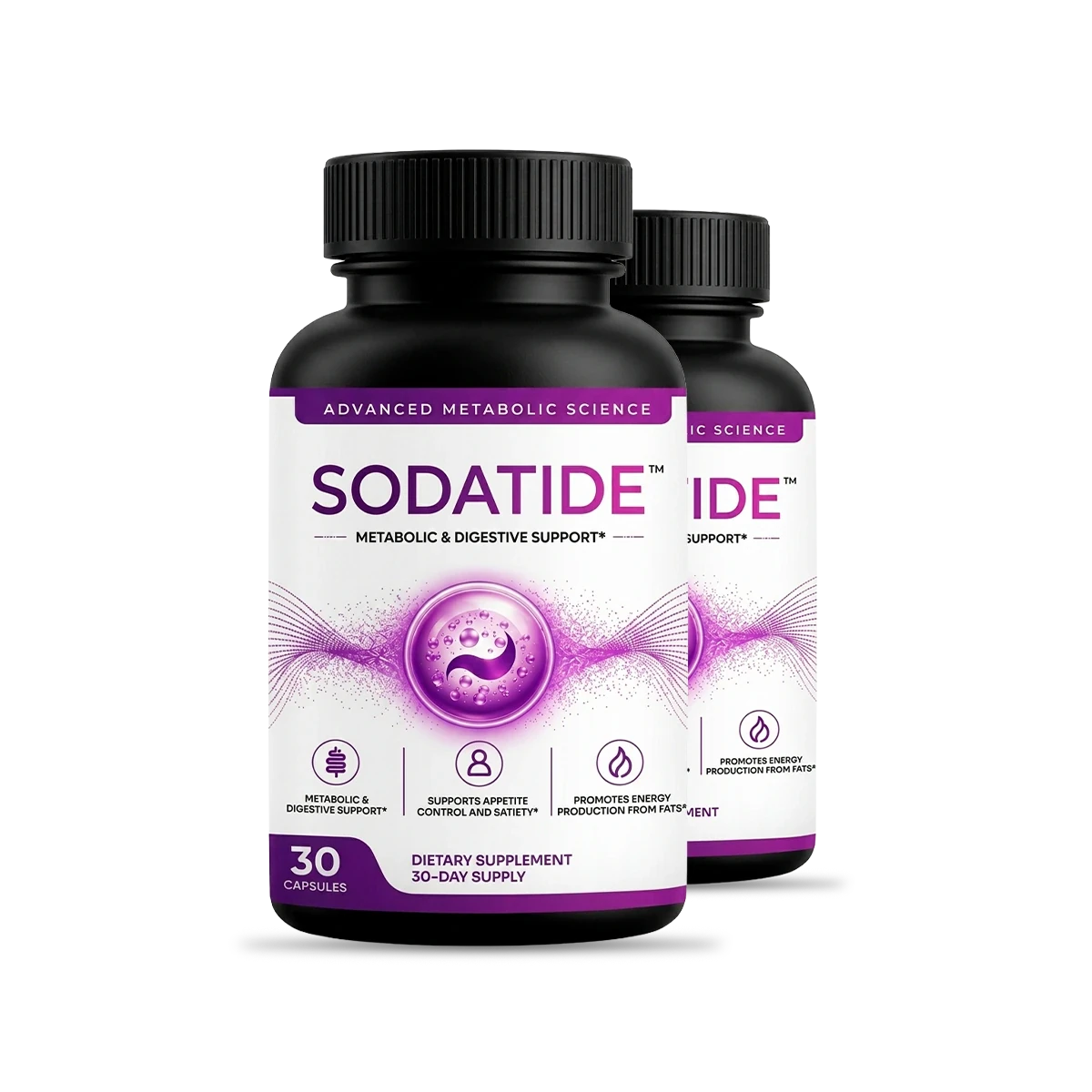
Try SodaTide on the official website
A mechanism with direct human evidence behind it, in a capsule the label will not put a number on. The 60-day window is how you find out which half matters more.
Two bottles $158 · six bottles $294 · 60-day money-back guarantee
Order SodaTide On The Official WebsiteOne capsule a morning · 30 per bottle · lot SOD-26/SO-1226