SodaTide Official Website › Choosing A Formula
Choosing A FormulaHow To Choose Between Two Metabolic Supplements
Four numbers decide whether a supplement label can be compared with a trial at all.
Grams of each fibre per serving, the strain designation of every organism, the colony count at the end of shelf life, and the servings per container. A label with all four can be checked. A label missing any of them has to be taken on trust, and that is a decision rather than an oversight.
A method for comparing two labels, usable on any product in this category including the one this website sells.
The four numbers, and what each one unlocks
Grams of each fermentable fibre per serving
This is the number the whole literature is keyed to. Five grams of inulin is the lowest dose with a published effect on gut bacteria; twelve to fifteen is where bowel outcomes were measured; sixteen is where energy intake moved. Without a gram figure none of that can be applied.
Genus, species and strain for every organism
Probiotic evidence belongs to strains, not to the word probiotic. A label naming Lactobacillus gasseri SBT2055 can be looked up. A label saying 'probiotic blend' cannot be looked up at all.
Colony-forming units at the end of shelf life
Not at manufacture. The second figure is the one a buyer receives, and the difference between the two is exactly what storage conditions and time do to a live product.
Servings per container, and the serving size
Turns a price into a cost per day, which is the only way two products at different pack sizes can be compared. It also reveals whether a headline dose requires two capsules or four.
Those four take about ninety seconds to check on a panel and they separate products that can be evaluated from products that cannot. Nothing in that sentence is a judgement about quality — an undisclosed formula may be excellent — but an undisclosed formula cannot be compared with anything, and comparison is the only tool a shopper has.
Reading a proprietary blend
A proprietary blend prints a total weight for several ingredients and no breakdown. It is legal, it is common, and it is designed to protect a formula from being copied. It also makes the formula impossible to assess.
The useful thing to know is that ingredients in a blend are listed in descending order by weight. So the first name carries more than the second, and the last name may be present in a quantity that rounds to nothing. A blend whose total is 500 mg across six botanicals cannot contain a clinically studied dose of more than one of them, and often not even that.
A label with no total at all — ingredient names and nothing else — is a step further again. It is not a blend with a hidden split; it is a list with no quantity information of any kind. That is the position this website's own product is in, and the ingredients page says so rather than working around it.
What a seal tells you, and what it does not
| Seal | What it actually certifies | What it does not |
|---|---|---|
| Made in the USA | Where manufacturing happened | Where the ingredients came from, or how much of each went in |
| GMP certified | That the facility documents and controls its processes | Anything about this batch's contents |
| FDA registered | That the facility has filed a registration | Approval of the product; no supplement is FDA-approved |
| Non-GMO | A sourcing decision about inputs | A quantity |
| Natural | Nothing checkable; the word is unregulated | Anything at all |
| Doctor formulated | Nothing, unless a clinician is named with a credential | Who, or with what qualification |
| Gluten free | A meaningful claim, worth checking against the panel | Whether the facility handles gluten elsewhere, unless stated |
| Third-party tested | Potentially a great deal — if a laboratory is named and a certificate is released | Anything, if the certificate is only referenced and never published |
Seven of these eight describe a building or a sourcing decision. Only the last can describe what is in the capsule, and only when the certificate actually exists.
The pattern worth internalising: seals are cheap to collect and quantities are expensive to disclose. A pack carrying eight marks and no amounts has made a choice about which kind of reassurance to offer, and a shopper is entitled to notice which one is missing.
Turning a price into a decision
Price per bottle is the wrong unit. Cost per day is the right one, and it is simple arithmetic: pack total divided by the days the pack covers.
Two further adjustments make the comparison honest. Add shipping, because a cheaper pack that charges postage may not be cheaper. And divide by the days you will actually take it rather than the days printed on the box — a six-month pack taken for two months costs three times its stated per-day figure.
Then hold that number against what else the money buys. Fermentable fibre from food costs pennies a day and requires cooking; a fibre powder costs less per gram than any capsule and requires stirring; a named-strain probiotic costs more and can be looked up. None of those is the right answer for everybody, and the arithmetic at least makes the trade visible.
- Write down the four numbers for each product. Any that are missing, write 'not stated'.
- Convert each price to a cost per day, including postage.
- Look up any named strain. Thirty seconds tells you whether it has trials behind it.
- Check the refund window and whether it is counted from purchase or delivery.
- Decide whether the product with fewer blanks is worth the difference. Very often it is.
Applying the method to the product this site sells
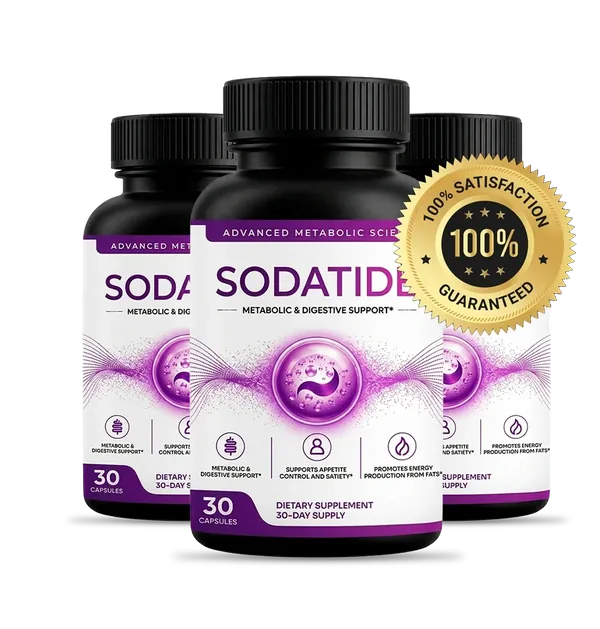
It would be dishonest to publish a method and exempt the product on the other pages from it, so: SodaTide scores badly on the first three of the four numbers and well on the fourth.
No gram figure for either fibre. No genus, species or strain for any organism. No colony count of any kind. Servings per container is clear — thirty capsules, one a day, thirty days — and the cost per day works out at $2.63 on the smallest pack and $1.63 on the largest.
What sits on the other side of that ledger is a formula built from ingredients with a real and large human literature, a refund window that is well matched to the time the mechanism takes, and a storage instruction that suggests the probiotic fraction is meant to arrive alive. A reader can weigh those against three blanks themselves, which is more use than being told what to conclude.
Who wrote this method
- Jager R, Mohr AE, Carpenter KC, et al. International Society of Sports Nutrition Position Stand: Probiotics. J Int Soc Sports Nutr. 2019;16(1):62. PMID 31864419. https://pubmed.ncbi.nlm.nih.gov/31864419/
- Gibson GR, Hutkins R, Sanders ME, et al. Expert consensus document: The International Scientific Association for Probiotics and Prebiotics (ISAPP) consensus statement on the definition and scope of prebiotics. Nat Rev Gastroenterol Hepatol. 2017;14(8):491-502. PMID 28611480. https://pubmed.ncbi.nlm.nih.gov/28611480/
- Kolida S, Meyer D, Gibson GR. A double-blind placebo-controlled study to establish the bifidogenic dose of inulin in healthy humans. Eur J Clin Nutr. 2007;61(10):1189-95. PMID 17268410. https://pubmed.ncbi.nlm.nih.gov/17268410/
- Bouhnik Y, Raskine L, Simoneau G, et al. The capacity of nondigestible carbohydrates to stimulate fecal bifidobacteria in healthy humans: a double-blind, randomized, placebo-controlled, parallel-group, dose-response relation study. Am J Clin Nutr. 2004;80(6):1658-64. PMID 15585783. https://pubmed.ncbi.nlm.nih.gov/15585783/
- Shehata HR, Newmaster SG. The power of DNA based methods in probiotic authentication. Front Microbiol. 2023;14:1158440. PMID 37138639. https://pubmed.ncbi.nlm.nih.gov/37138639/
- Kesavelu D Sr, Rohit A, Karunasagar I, et al. Composition and Laboratory Correlation of Commercial Probiotics in India. Cureus. 2020;12(11):e11334. PMID 33173652. https://pubmed.ncbi.nlm.nih.gov/33173652/
- Micka A, Siepelmeyer A, Holz A, et al. Effect of consumption of chicory inulin on bowel function in healthy subjects with constipation: a randomized, double-blind, placebo-controlled trial. Int J Food Sci Nutr. 2017;68(1):82-89. PMID 27492975. https://pubmed.ncbi.nlm.nih.gov/27492975/
- Verhoef SP, Meyer D, Westerterp KR. Effects of oligofructose on appetite profile, glucagon-like peptide 1 and peptide YY3-36 concentrations and energy intake. Br J Nutr. 2011;106(11):1757-62. PMID 21679485. https://pubmed.ncbi.nlm.nih.gov/21679485/
- Reynolds A, Mann J, Cummings J, et al. Carbohydrate quality and human health: a series of systematic reviews and meta-analyses. Lancet. 2019;393(10170):434-445. PMID 30638909. https://pubmed.ncbi.nlm.nih.gov/30638909/
- Questions and Answers on Dietary Supplements. U.S. Food and Drug Administration. https://www.fda.gov/food/information-consumers-using-dietary-supplements/questions-and-answers-dietary-supplements
- Dietary Supplements: What You Need to Know. Office of Dietary Supplements, National Institutes of Health. https://ods.od.nih.gov/factsheets/WYNTK-Consumer/