SodaTide Official Website › Blog › What A Probiotic Blend Does Not Tell You
“Probiotic Blend”: The Two Words That Close A Label
Probiotic evidence belongs to strains the way a drug result belongs to a molecule. A label that prints a genus, a species and a strain designation can be looked up in about thirty seconds. A label that prints the words “probiotic blend” cannot be looked up at all.
- Probiotic effects are strain-specific and dose-specific. That is not a nuance; it is the central fact of the field.
- A strain designation is a code like SBT2055, and it is what a trial is conducted on.
- A colony count at the end of shelf life is the figure a buyer actually receives; a count at manufacture is not.
- Two trials of the same strain found abdominal fat reductions; a review of the same genus found results differing by species.
- A blend naming none of these cannot be matched to any trial, in either direction.
Why strains, not species
The ISSN position stand on probiotics states it as plainly as any document in the field: despite shared core mechanisms, the health benefits of probiotics are strain- and dose-dependent, and the minimum effective dose and method of administration for a specific strain depend on validation studies for that strain. It goes on to say that products containing probiotics must include the genus, species and strain of each live microorganism on the label, as well as the total estimated quantity of each strain at the end of shelf life.
That is a strong statement and it is not controversial. The reason is biological rather than bureaucratic: two strains of the same species can differ in which surface proteins they carry, which bile salts they survive, which metabolites they produce and which part of the gut they adhere to. Treating them as interchangeable is like treating two molecules as interchangeable because they share a carbon skeleton.
A review restricted to Lactobacillus makes the point from the other direction. Looking only at overweight adults and only at one genus, it found results splitting by species: some reduced body weight and body fat, some did nothing, and one was associated with weight gain. Same genus, opposite outcomes.
What a probiotic label should carry
| What a probiotic label should carry | Why it matters | What it unlocks |
|---|---|---|
| Genus | The broadest useful grouping | Almost nothing on its own. Lactobacillus covers organisms with opposite results |
| Species | Narrows it considerably | You can find the relevant literature, though not the relevant trial |
| Strain designation | The unit every trial is conducted on | You can look up the actual study, its dose and its outcome |
| Colony-forming units per serving | The dose | You can compare the product with the trial's amount |
| Count at the end of shelf life | What a buyer actually receives | You can tell whether the count is a manufacturing figure or a delivered one |
| Storage instruction | How the count is meant to be protected | A refrigeration line suggests the organisms are intended to arrive alive |
Six rows, and the third is the one that turns a label into something checkable.
Six rows, and the practical test is simple: can you type what the label says into a search box and find a study? With a strain designation the answer is yes and it takes about thirty seconds. With a species alone the answer is a literature rather than a trial. With the words “probiotic blend” the answer is no.
The last row is the one worth dwelling on for this particular product, because it is the only one this label does answer. A refrigeration instruction is an inconvenient thing for a manufacturer to print — it complicates shipping, retail and travel — and the usual reason to print it anyway is that something inside would rather be cold. That is a genuine signal, and it is discussed in full in the post on the fridge instruction.
See what the SodaTide label does and does not name
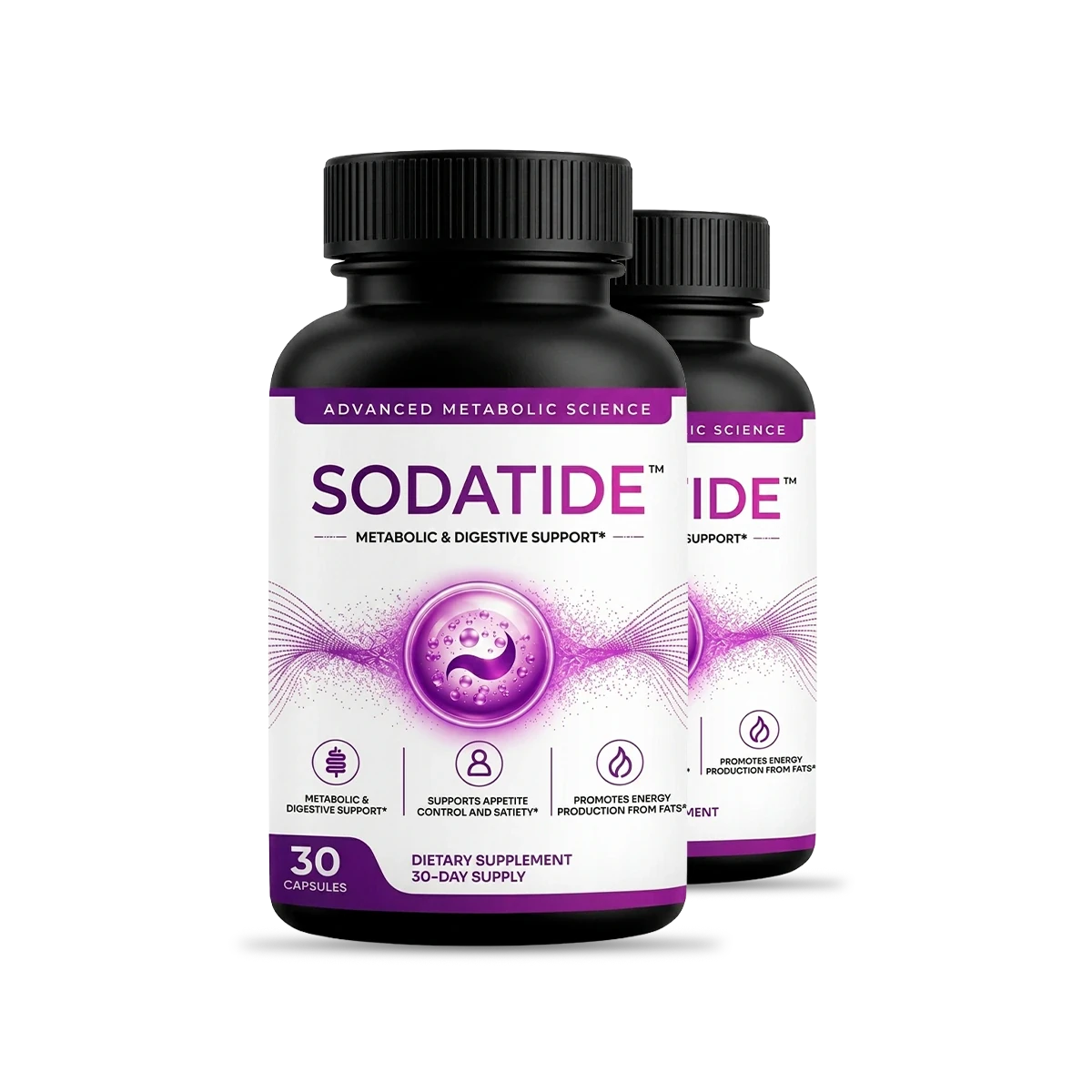
The ingredients page sets out all three named ingredients, including the probiotic blend and everything it leaves unstated, with a 60-day window behind the purchase.
Two bottles $158 · six bottles $294 · 60-day money-back guarantee
Order SodaTide On The Official WebsiteOne capsule a morning · 30 per bottle · lot SOD-26/SO-1226
A worked example, in two papers
| Trial | Strain, named in the title | Dose | Duration | Result |
|---|---|---|---|---|
| Kadooka 2010 | Lactobacillus gasseri SBT2055 | 10⁸ cfu/g in 200 g of fermented milk a day | 12 weeks | Abdominal visceral fat area fell 4.6% from baseline |
| Kadooka 2013 | Lactobacillus gasseri SBT2055 | 10⁷ and 10⁶ cfu/g in 200 g a day | 12 weeks | Visceral fat area fell about 8% at both concentrations |
| Crovesy 2017 | Several Lactobacillus species, reviewed | Varied | Varied | Results differed by species; one was associated with weight gain |
Two of the three name the strain in the title of the paper, because the strain is the finding.
The first of those papers enrolled 87 adults with a body mass index between 24.2 and 30.7 and abdominal visceral fat areas between 81 and 179 square centimetres, gave half of them fermented milk containing Lactobacillus gasseri SBT2055 at 10⁸ colony-forming units per gram and half the same milk without it, 200 g a day for twelve weeks, and measured abdominal fat by computed tomography. Visceral fat area fell by an average of 4.6% from baseline in the active group.
The follow-up asked whether lower concentrations worked, which is the question a manufacturer would need answered before formulating a product. Two hundred and ten healthy Japanese adults with large visceral fat areas were randomised to 10⁷, 10⁶ or zero colony-forming units per gram, again 200 g a day for twelve weeks. Visceral fat area fell about 8% in both active groups.
Notice what those two papers make possible. A reader can find the strain, the dose, the vehicle, the duration, the population and the measurement method, and can then ask whether a given product matches any of them. That is what a strain designation buys, and it is exactly what a blend without one withholds.
What audits of probiotic labels have found
- DNA-based authentication methods exist for probiotics specifically because identity has not always matched the label, and third-party evaluation of label accuracy is recommended for manufacturers.
- A laboratory audit of commercial probiotic products found poor correlation between label claims and measured identity, viability, organism counts and purity.
- Neither of those is an accusation about any particular product. They are the reason a specific label is worth more than a vague one: a specific claim can be tested and a vague one cannot be.
- A label naming no organism is not passing an audit. It is not taking one.
What a buyer can actually do
- Read the panel on the bottle that arrives. Marketing artwork and the container are not always the same document, and US rules require a panel on the container.
- If a strain is named there, look it up. Thirty seconds tells you whether it has trials behind it and at what dose.
- If a colony count is given, check whether it is at manufacture or at the end of shelf life. The second is the one you receive.
- Store it the way the label asks. A count protected by refrigeration is not protected by a warm cupboard.
- If the panel differs from anything on this website, the panel governs — and this desk would like to hear about it through the contact page.
What the mixed-strain evidence does support
Separating two claims here is worth the paragraph, because the criticism above is about labelling rather than about probiotics as a class.
Pooled across many products and many strains, probiotics in adults with overweight or obesity produce small, consistent reductions in body weight and fat percentage. Several independent meta-analyses reach that conclusion, and the effect sizes they report are modest rather than negligible. So a blend of reasonable organisms at a reasonable count is not a placebo, and nothing in this post argues that it is.
The problem is that a buyer cannot tell whether a given product is that blend. Pooled results describe an average across products whose labels DID name what was in them, because that is how a trial gets conducted. An unlabelled blend is not represented in those averages; it is a product about which nothing has been measured. Treating the pooled figure as though it applied would be borrowing a result earned by other people's disclosure.
There is a second, quieter reason a strain list would help even a sceptical reader. Some organisms in this space have a substantial literature, some have almost none, and a few have results pointing the wrong way for the outcome a product is sold for. A named blend lets a reader weight the formula accordingly. An unnamed one collapses all three possibilities into a single phrase and asks the buyer to assume the first.
It is not saying an unnamed blend is inert, and it is not saying the organisms are not there. It is saying that a label without a strain designation cannot be checked against the literature by anybody, including this desk, and that a reader is entitled to know which of those two situations they are in.
The full treatment, including where the seller's own page names an organism the bottle does not, is on the SodaTide ingredients page. The method for comparing two labels generally is in the choosing guide.
References
- International Society of Sports Nutrition Position Stand: Probiotics, by Jager R, Mohr AE, Carpenter KC, et al (J Int Soc Sports Nutr 2019;16(1):62; PMID 31864419) · open the PubMed record
- Regulation of abdominal adiposity by probiotics (Lactobacillus gasseri SBT2055) in adults with obese tendencies in a randomized controlled trial, by Kadooka Y, Sato M, Imaizumi K, et al (Eur J Clin Nutr 2010;64(6):636-43; PMID 20216555) · open the PubMed record
- Effect of Lactobacillus gasseri SBT2055 in fermented milk on abdominal adiposity in adults in a randomised controlled trial, by Kadooka Y, Sato M, Ogawa A, et al (Br J Nutr 2013;110(9):1696-703; PMID 23614897) · open the PubMed record
- Effect of Lactobacillus on body weight and body fat in overweight subjects: a systematic review of randomized controlled clinical trials, by Crovesy L, Ostrowski M, Ferreira DMTP, et al (Int J Obes (Lond) 2017;41(11):1607-1614; PMID 28792488) · open the PubMed record
- The power of DNA based methods in probiotic authentication, by Shehata HR, Newmaster SG (Front Microbiol 2023;14:1158440; PMID 37138639) · open the PubMed record
- Composition and Laboratory Correlation of Commercial Probiotics in India, by Kesavelu D Sr, Rohit A, Karunasagar I, et al (Cureus 2020;12(11):e11334; PMID 33173652) · open the PubMed record