SodaTide Official Website › Blog › Resistant Starch: Potato Or Capsule
Potato Resistant Starch: What The Trial Actually Fed People
The one trial that used potatoes rather than maize gave nineteen adults three hundred grams of cooked, chilled potato a day — about two potatoes, and roughly eighteen grams of resistant starch. That is the comparison any capsule has to be read against.
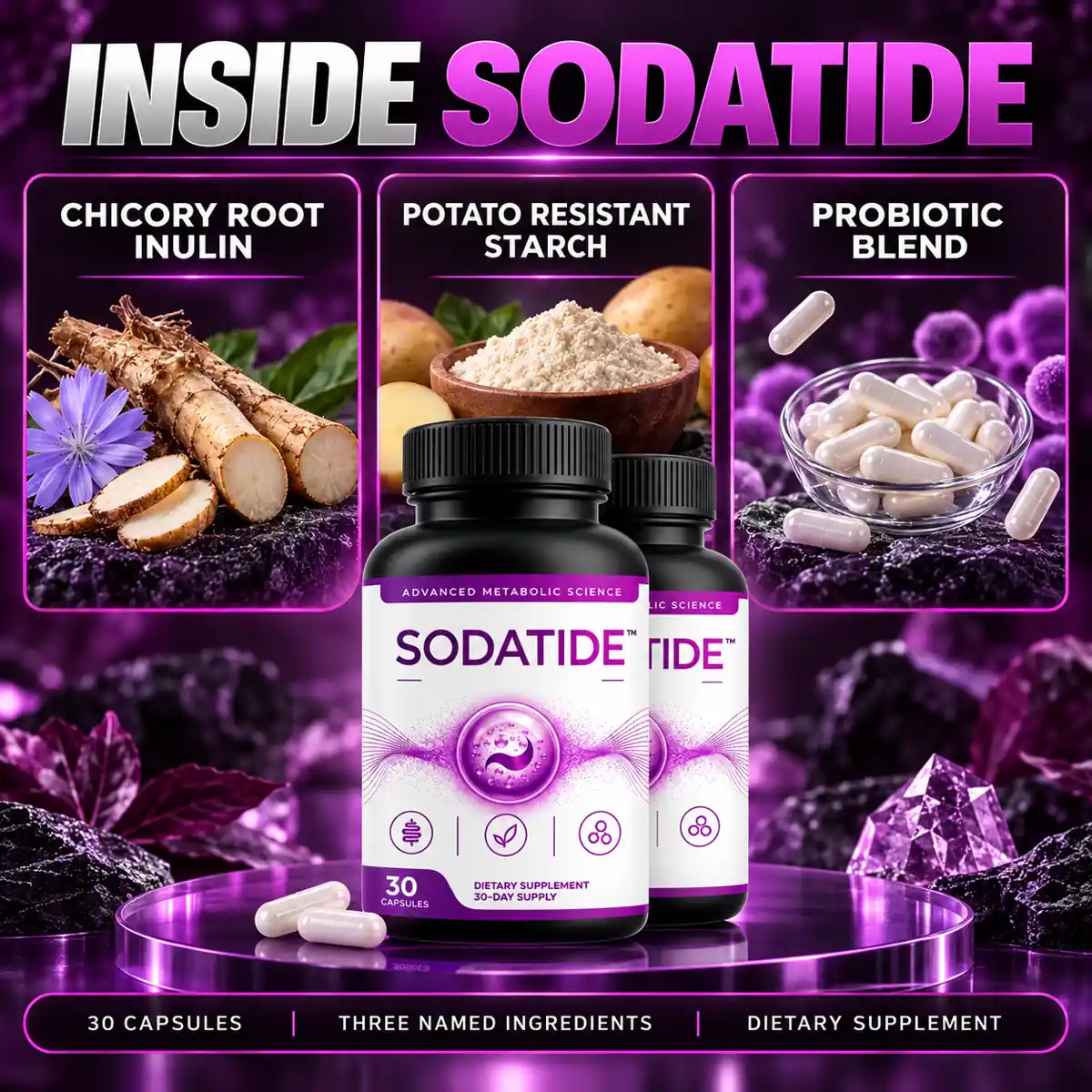
- Resistant starch is ordinary starch in a physical form amylase cannot digest. Cooking and chilling a potato produces it.
- The potato trial used 300 g a day of cooked, chilled potato, about 18 g of resistant starch, in a 19-person pilot.
- The 12-week trials used 40 to 45 g a day of high-amylose maize.
- At 40 g a day insulin sensitivity improved. At 45 g a day appetite did not move at all.
- This is the one ingredient in the formula a reader can manufacture in a kitchen for nothing.
What resistant starch is
Starch is a chain of glucose units and the small intestine is extremely good at taking it apart. Resistant starch is the same molecule arranged into a physical structure the enzyme cannot get at — either locked inside an intact plant cell, packed into a granule the enzyme cannot penetrate, or recrystallised after cooking into a form it no longer recognises.
The third kind is the one a kitchen produces. Cook a potato and the starch gelatinises; chill it and a fraction recrystallises into a structure that passes the small intestine intact. Reheat it gently and much of that survives. Cold potato salad, yesterday's rice and a cooled, reheated portion of pasta all carry more resistant starch than the same food eaten hot from the pan.
Once it reaches the colon it behaves like any other fermentable substrate: bacteria break it down and produce short-chain fatty acids. DeMartino and Cockburn make the point that which bacteria benefit depends on the granule structure, so two products both labelled resistant starch can ferment differently and feed different organisms.
What the trials fed people
| Trial | Source of resistant starch | Dose | Duration | Result |
|---|---|---|---|---|
| Sanders 2021 | Cooked, chilled potato — 300 g a day | ~18 g | 24 hours | A pilot in 19 adults, measuring insulin sensitivity the next morning |
| Johnston 2010 | High-amylose maize supplement | 40 g a day | 12 weeks | Improved insulin sensitivity by clamp; no change in body weight or ectopic fat |
| Gower 2016 | High-amylose maize supplement | Not stated in the abstract | Crossover | The response in women depended on baseline insulin sensitivity |
| White 2020 | High-amylose maize supplement | 45 g a day | 12 weeks | No effect on appetite, food intake, GLP-1, PYY or ghrelin in prediabetes |
| Al-Mana 2018 | Resistant starch at breakfast and lunch | 48 g | Acute | Less energy eaten at a later meal; no change in how full anyone said they felt |
Every dose and duration read from the paper's own abstract.
The potato trial is worth reading carefully because it is the only one that used the food this ingredient is named after. Nineteen adults with a body mass index between 27 and 40 ate 300 g a day of cooked, then chilled potato — described in the paper as approximately two potatoes and about 18 g of resistant starch — spread across lunch, an evening meal and a snack over 24 hours, against isoenergetic carbohydrate control foods. Insulin sensitivity was measured the next morning after an overnight fast. It was a pilot and its authors call it one.
The longer trials used high-amylose maize. One gave 40 g a day for twelve weeks to insulin-resistant adults and measured improved insulin sensitivity by euglycaemic clamp, with no change in body weight or in fat stored in muscle, liver or visceral depots. Another gave 45 g a day for twelve weeks to adults with prediabetes and found no effect at all on appetite ratings, on energy intake at a buffet, or on GLP-1, peptide YY and ghrelin.
See how SodaTide sets these figures out in full
The ingredients page prints all three named ingredients beside the doses their trials used, including every figure in this article, with a 60-day window behind the purchase.
Two bottles $158 · six bottles $294 · 60-day money-back guarantee
Order SodaTide On The Official WebsiteOne capsule a morning · 30 per bottle · lot SOD-26/SO-1226
A potato against a capsule
| A potato, cooked and chilled | A capsule | |
|---|---|---|
| Quantity of resistant starch | About 18 g from 300 g of potato | Not stated on this label; well under a gram in total |
| Cost | Pennies | Dollars a day |
| Effort | Cook, chill, eat cold or gently reheated | Four seconds |
| Reliability of the dose | Varies with variety, cooking and chilling | Unknown, because it is not printed |
| What else comes with it | Potassium, vitamin C, water, satiety from volume | Whatever else is in the formula |
| Does the literature use it | Yes, in one pilot | No trial has tested a capsule dose |
The left column is what Sanders 2021 actually fed people. The right is what this product's own artwork states, which is a name and no figure.
That table is uncomfortable for a retailer and it is the honest comparison. Two potatoes, cooked and left in the fridge overnight, deliver a quantity of resistant starch that has actually been tested. A capsule holding under half a gram of everything combined delivers a quantity nobody has tested, because nobody would design a trial around it.
What the capsule has is everything the potato does not: no cooking, no planning, no refrigerator full of cold potatoes, and a routine that survives a week when the kitchen does not get used. Those are real advantages and they are the honest case for the form. They are not a case for the dose.
A review of resistant starch and energy balance makes the underlying point in one line: resistant starch is a substrate, and a substrate has to be present in gram quantities to be fermented in gram quantities. There is no potency argument available here of the kind that works for a vitamin or a botanical extract.
Not all resistant starch is the same
- Type 1 is physically trapped inside intact plant cell walls — whole grains, seeds, legumes.
- Type 2 is a native granule the enzyme cannot penetrate, such as raw potato starch or green banana.
- Type 3 is retrograded: cooked and then cooled, which is what happens to a chilled potato.
- Type 4 is chemically modified and is a food-industry ingredient rather than a kitchen product.
- Most of the supplement literature uses type 2 from high-amylose maize, which is not the same thing as either raw potato starch or a retrograded potato.
A label that says “potato resistant starch” and nothing else leaves at least two questions open: which type, and how much. A systematic review of resistant starch and obesity found the metabolic signals stronger than the anthropometric ones across the literature, which makes the type question more than pedantry — the metabolic results are the ones most tied to a specific preparation at a specific dose.
What to do with this
- If insulin sensitivity is what interests you, the evidence is at 40 g a day for twelve weeks, and that is a supplement powder or a substantially rearranged diet.
- If appetite is what interests you, the best-conducted resistant starch trial found nothing at 45 g a day over twelve weeks. Look at the inulin literature instead.
- If you want the ingredient for nothing, cook potatoes or rice, chill them overnight, and eat them cold or gently reheated.
- If you want a capsule for the routine rather than the dose, that is a defensible reason and this article is not arguing against it.
- Either way, read the panel on the bottle that arrives and compare it against the ingredients page figures.
Making resistant starch in a kitchen
- Cook potatoes, rice, pasta or beans normally. Gelatinising the starch is the step that makes retrogradation possible afterwards.
- Chill the cooked food in a refrigerator, ideally overnight. This is where a fraction of the starch recrystallises into the form the small intestine leaves alone.
- Eat it cold, or reheat it gently. Much of the retrograded fraction survives a gentle reheat, which is why yesterday's rice is not the same food as this evening's.
- Introduce it gradually. Going from very little fermentable carbohydrate to a large portion of cold potato salad in one day produces exactly the wind this whole category is known for.
- Do not expect a number. The quantity varies with the variety, the cooking method and how long it was chilled, which is the honest disadvantage of the kitchen route.
That last point is the real trade-off and it deserves to be said clearly rather than buried. A supplement gives you a figure, or at least it should. A kitchen gives you the ingredient at almost no cost and no figure at all, and somebody who wants to know how many grams they ate will never find out from a potato.
For most people that does not matter, because the population-level evidence about fibre is about eating more of it rather than about hitting a target. For somebody trying to reproduce a specific trial, it matters a great deal, and the answer there is a measured supplement rather than a vegetable or a capsule.
A bag of potatoes and a refrigerator. It is the only ingredient in this formula that can be produced at home, and saying so is more useful to a reader than any amount of writing about granule structure.
References
- Effects of potato resistant starch intake on insulin sensitivity, related metabolic markers and appetite ratings in men and women at risk for type 2 diabetes: a pilot cross-over randomised controlled trial, by Sanders LM, Dicklin MR, Palacios OM, et al (J Hum Nutr Diet 2021;34(1):94-105; PMID 33119948) · open the PubMed record
- Resistant starch improves insulin sensitivity in metabolic syndrome, by Johnston KL, Thomas EL, Bell JD, et al (Diabet Med 2010;27(4):391-7; PMID 20536509) · open the PubMed record
- Resistant Starch Has No Effect on Appetite and Food Intake in Individuals with Prediabetes, by White U, Peterson CM, Beyl RA, et al (J Acad Nutr Diet 2020;120(6):1034-1041; PMID 32280055) · open the PubMed record
- Resistant starch and energy balance: impact on weight loss and maintenance, by Higgins JA (Crit Rev Food Sci Nutr 2014;54(9):1158-66; PMID 24499148) · open the PubMed record
- Resistant starch: impact on the gut microbiome and health, by DeMartino P, Cockburn DW (Curr Opin Biotechnol 2020;61:66-71; PMID 31765963) · open the PubMed record
- Impact of dietary intake of resistant starch on obesity and associated metabolic profiles in human: a systematic review of the literature, by Guo J, Tan L, Kong L (Crit Rev Food Sci Nutr 2021;61(6):889-905; PMID 32321291) · open the PubMed record