SodaTide Official Website › Blog › Inulin Isn't One Thing
Inulin Isn't One Thing: Chain Length And This Label's Silence
Inulin is not a single molecule; it is a family of fructan chain lengths that do not all behave alike. A 200-person dose-response study found long-chain inulin was not bifidogenic in screening while short-chain FOS was. SodaTide's label never says which form is inside — a separate silence from the missing gram figure.
- “Inulin” is not one molecule; it is a family of fructan chain lengths, from short-chain fructo-oligosaccharides (FOS) through long native inulin.
- A 200-person dose-response study (Bouhnik 2004) screened seven carbohydrates and found long-chain inulin was NOT bifidogenic in its screening phase, while short-chain FOS was.
- Lactulose and isomalto-oligosaccharides also failed to raise bifidobacteria in that same screening.
- A separate trial (Kolida 2007) found native inulin bifidogenic at 5 g and 8 g over two weeks — a reminder that form, dose and duration interact.
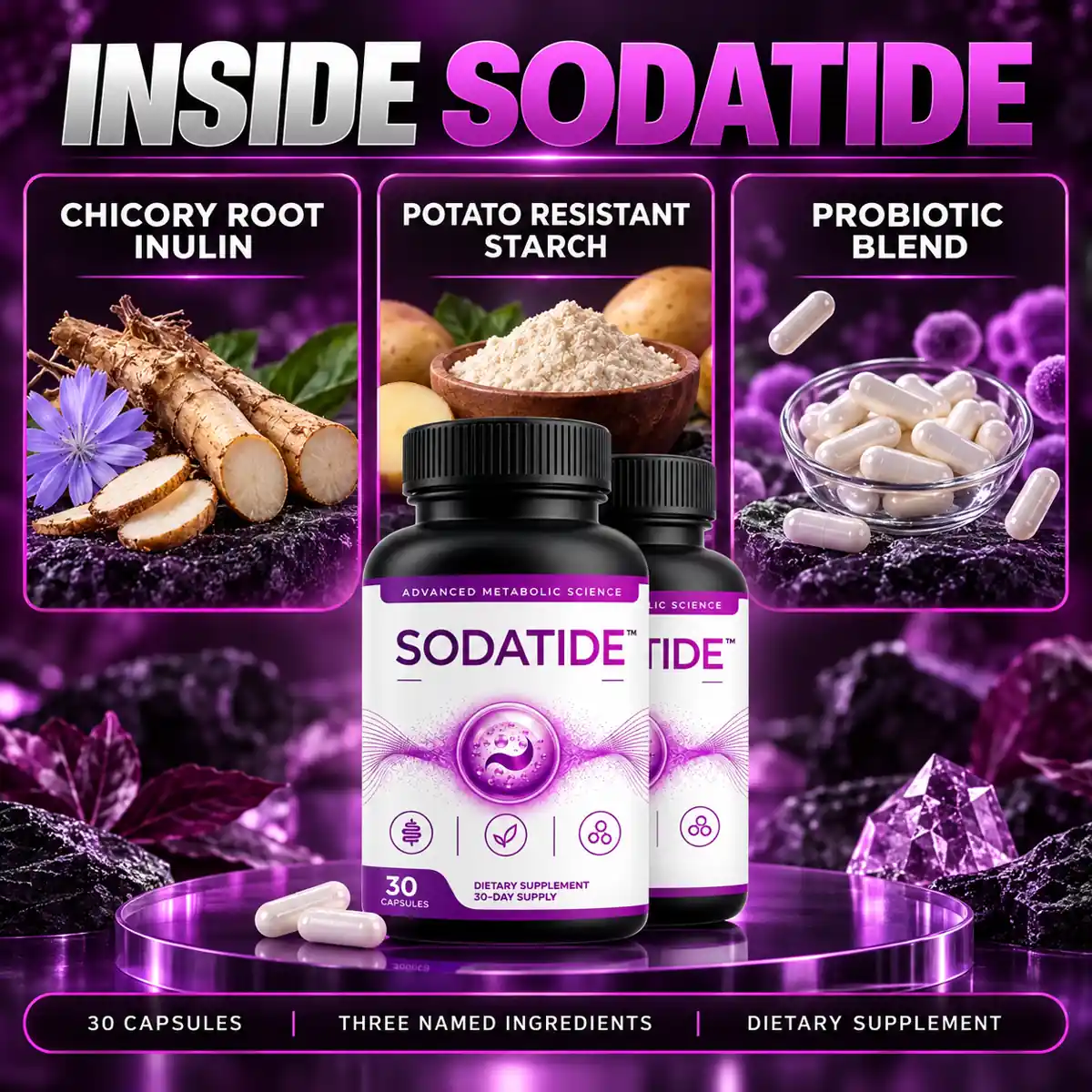
- SodaTide's label names “chicory root inulin” without specifying chain length or form, on top of printing no gram amount.
What “inulin” actually covers
Inulin is not one molecule. It is a family of fructans — chains of fructose units joined end to end and capped with a single glucose — that share a chemical backbone but differ in how long that chain runs. Chemists describe chain length as degree of polymerization, or DP: the number of sugar units strung together in a single molecule. Short fragments, with a DP in the low single digits up to around ten, are usually called fructo-oligosaccharides, or FOS. Longer chains, running up toward sixty units, are what most sources mean by native or long-chain inulin. A finished ingredient labelled simply “inulin” can sit almost anywhere on that spectrum, and a plant like chicory root does not produce one uniform chain length — it produces a distribution, a mixture of shorter and longer fructans in proportions that depend on the plant, the season, and how the extract is processed afterward.
That distinction is not academic hair-splitting. The ISAPP consensus definition of a prebiotic requires selective utilisation by host microorganisms conferring a health benefit, and “selective” is doing real work in that sentence. Different chain lengths are not fermented identically by the same gut bacteria, are not fermented at the same rate, and are not necessarily fermented in the same part of the colon. Shorter chains tend to be consumed faster and further upstream; longer chains travel further before they are broken down. A supplement that simply says “inulin” is naming a category, not a compound, and the category contains members that behave differently in exactly the outcome this kind of product is sold on: shifting the balance of gut bacteria.
SodaTide's own ingredients page names chicory root inulin as the first of three ingredients. It does not say which portion of the chain-length spectrum this particular extract sits in. That is a second silence, stacked on top of the label's more obvious one about quantity, and it is the silence this article is about.
The 200-person study that tested seven carbohydrates at once
Bouhnik and colleagues published a dose-response study in the American Journal of Clinical Nutrition in 2004 that is, as far as this category of evidence goes, unusually well designed for answering exactly the question this article is asking. Roughly 200 healthy volunteers were enrolled in a double-blind, randomized, placebo-controlled, parallel-group design, and seven different nondigestible carbohydrates were screened at doses from 2.5 to 10 grams a day.
Four of the seven raised faecal bifidobacteria against placebo: short-chain fructo-oligosaccharides, soybean oligosaccharides, galacto-oligosaccharides, and type III resistant starch. Three did not: lactulose, isomalto-oligosaccharides — and long-chain inulin. Read that list again slowly, because it is the whole point of this article in miniature. Short-chain fructo-oligosaccharides, tested in the same study, under the same conditions, by the same investigators, raised bifidobacteria. Long-chain inulin, tested alongside it, did not. Same broad chemical family. Same study. Different outcome, tied directly to chain length.
This is not a fringe or contested result quietly sitting in one obscure paper. It is precisely the kind of head-to-head comparison that a category this crowded with single-ingredient trials rarely gets, and it lands on a conclusion that should reshape how anyone reads an “inulin” label from that point forward: the word does not specify the molecule closely enough to predict the outcome.
Why this is a form question, not a dose question
This site has already published an article on chicory inulin and the dose question — on how many grams a day the published trials fed people, from the five grams that raised bifidobacteria in one study up through the sixteen grams that moved energy intake in another. That article tracks a single variable: quantity. Given enough of the right substance, does something measurable happen, and at what amount does the answer flip from no to yes?
This article is tracking a different variable entirely, and it is worth being explicit about the difference rather than leaving it implied. The dose question asks: how much of a given inulin do you need? This article asks: which inulin is it, before the dose question can even be asked meaningfully? A dose figure is only informative once the substance being dosed is specified closely enough that the figure means something consistent across studies. Five grams of short-chain FOS and five grams of long-chain inulin are not the same intervention, based on the Bouhnik screening above, even though both would print as “5 g inulin” on a hypothetical label that specified quantity but not form.
SodaTide's label specifies neither. It is missing the dose figure this site's other article on the subject already covers in full, and it is missing the chain-length or form specification this article is about. Those are two separate gaps, not one gap described twice, and a reader trying to evaluate this ingredient against the published literature needs both pieces of information to do it — not because either gap alone is fatal, but because dose only becomes meaningful once form is fixed.
An analogy from outside supplements makes the distinction concrete. “Sugar” on a label can mean table sugar, fruit sugar, or a dozen other things chemically related but metabolically distinct, and nutrition science stopped treating “sugar” as one substance decades ago precisely because lumping them together obscured real differences in how the body handles each one. Inulin has not yet received that same level of public scrutiny, in part because it is a newer ingredient to mainstream supplement shelves and in part because, until a study like Bouhnik's put several chain lengths through the same protocol side by side, the differences were harder to demonstrate cleanly. The evidence for treating chain length as a meaningfully separate variable now exists. Most labels, including this one, have not caught up to it.
The complication: a different trial, a different result
A tidier version of this article would stop at the Bouhnik finding and conclude that long-chain inulin simply does not work. The literature does not permit that conclusion, and the honest version of this article has to include the trial that complicates it. Kolida and colleagues, in a double-blind, placebo-controlled crossover published in 2007, set out specifically to establish the bifidogenic dose of inulin in healthy adults. Thirty volunteers received 5 grams and 8 grams a day, each for two weeks, in a chocolate drink. Both doses raised bifidobacteria against placebo, with a higher proportion of volunteers responding at the higher dose.
On the surface, that looks like a direct contradiction of the Bouhnik screening: one study finds inulin bifidogenic, another finds it is not. The resolution is not that one study is wrong. It is that “inulin” in each paper's abstract is doing the same job the word does on a supplement label — naming a category without fully specifying the molecule — and the two trials differ on variables beyond the word itself. The Kolida trial ran each dose for two full weeks; the Bouhnik screening phase ran for seven days. The two studies are not guaranteed to have sourced chemically identical extracts, and neither paper's published abstract, on its own, settles whether the inulin fraction tested in each was matched for chain-length distribution.
That uncertainty is itself the finding this article wants a reader to take away. Two well-conducted trials, both studying something called inulin, reached different conclusions about the same basic outcome, and chain length is one of the more plausible reasons why — alongside duration, dose, and population. A single word on a label cannot carry enough information to predict which of these two outcomes a given product is more likely to produce, and that is true whether the word appears with a gram figure beside it or, as on this bottle, without one.
| Bouhnik 2004 | Kolida 2007 | |
|---|---|---|
| What was tested | Long-chain inulin, one of seven carbohydrates screened | Inulin, at two doses, as the sole intervention |
| Dose | Up to 10 g a day within the screening range | 5 g and 8 g a day |
| Duration | 7 days | 2 weeks per dose, crossover |
| Bifidogenic result | No | Yes, at both doses |
| Sample size | ∼200 healthy volunteers | 30 healthy adults |
Figures as read from each paper's own published record. Neither abstract specifies whether the inulin extracts in the two trials were chain-length-matched to one another.
Three things move together when a fructan's chain length changes, and a single word on a label collapses all three into one. Fermentation speed changes: shorter chains are typically broken down faster. Fermentation location changes: shorter chains tend to be consumed further upstream in the colon, longer chains further along it. And, as the Bouhnik screening shows directly, whether a measurable bifidogenic effect appears at all can change. A label that says only “inulin” is silent on all three, not just one.
What chicory root actually contains
Chicory root is the standard commercial source for inulin, and it is worth being clear about what extraction from that root actually yields. The root does not store a single, uniform-length fructan. It stores a distribution: a mixture of chain lengths ranging from short fragments up through long native inulin, in proportions that shift with the plant's age and growing season. Raw chicory extract is, by its nature, a blend across that distribution rather than a single defined compound.
Manufacturers can and do process that raw extract further. Some products are sold as native or long-chain inulin, selected or enriched toward the longer end of the distribution. Others are sold as oligofructose, produced by partially hydrolysing longer chains down into the shorter fragments that behaved differently in the Bouhnik screening above. Still others are sold as blends explicitly combining both fractions to try to capture the fermentation profile of each. This site's own article on chicory inulin and the dose question sets out four commercial forms — powder, food-based fibre, a fibre capsule, and a fibre gummy — compared on serving size and trade-offs; the distinction this article is drawing is one level further back, about which fraction of the chain-length spectrum any of those forms actually delivers.
SodaTide's ingredients page names “chicory root inulin” without specifying which of these processed forms, or which point on the raw distribution, this bottle's extract represents. Given the Bouhnik and Kolida results sitting side by side, that is not a small omission.
What a label that named the form would say
A useful inulin label does not need a chemistry degree to read. It needs, at minimum, a statement of which type of inulin is present — native long-chain, oligofructose, or a specified blend of the two — printed beside the gram figure this site's other article on the subject already asks for. Together, those two pieces of information would let a reader hold a specific product up against a specific trial and ask a meaningful question: is this the form and the amount that produced an effect, or is it not?
Neither figure is a trade secret, and neither is unusual to print. Serious fibre powders routinely specify which fructan fraction they contain, because buyers of powder measured by the gram have learned to ask. A capsule that omits both the amount and the form is not doing anything uniquely deceptive by the standards of this category — but it is asking a reader to accept on faith two separate variables that the published research treats as decisive, and this article exists so that gap is recorded rather than assumed away.
References
- Bouhnik Y, Raskine L, Simoneau G, et al. The capacity of nondigestible carbohydrates to stimulate fecal bifidobacteria in healthy humans: a double-blind, randomized, placebo-controlled, parallel-group, dose-response relation study. Am J Clin Nutr. 2004;80(6):1658-64. PMID 15585783. https://pubmed.ncbi.nlm.nih.gov/15585783/
- Kolida S, Meyer D, Gibson GR. A double-blind placebo-controlled study to establish the bifidogenic dose of inulin in healthy humans. Eur J Clin Nutr. 2007;61(10):1189-95. PMID 17268410. https://pubmed.ncbi.nlm.nih.gov/17268410/
- Gibson GR, Hutkins R, Sanders ME, et al. Expert consensus document: The International Scientific Association for Probiotics and Prebiotics (ISAPP) consensus statement on the definition and scope of prebiotics. Nat Rev Gastroenterol Hepatol. 2017;14(8):491-502. PMID 28611480. https://pubmed.ncbi.nlm.nih.gov/28611480/